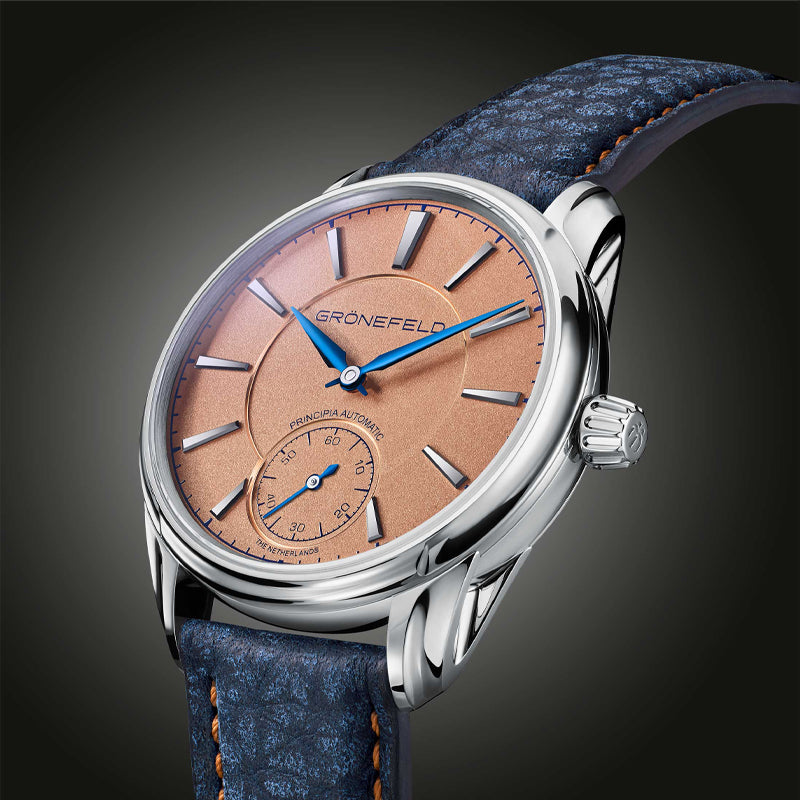
Bart and Tim, the brothers behind Grönefeld, make complicated watches next to the Saint Plechelmus Basilica in Oldenzaal, where their grandfather opened his workshop in 1912.
How it began
Johan Grönefeld was born in Oldenzaal on 14 July 1896. Taught by his uncle, he set up his workshop and boutique in 1912, in the shadow of Saint Plechelmus, a basilica and tower dating from 1240. He also looked after the church’s clock. His son Sjef, born in 1941, joined the business in 1962 and took over the care of the basilica clock in 1974.
Bart, born in 1969, and Tim, born in 1972, played as children in their grandfather’s workshop. Both trained as watchmakers and then worked in Switzerland at Renaud et Papi in Le Locle. Bart handled perpetual calendars, double split chronographs and minute repeaters, and was nicknamed Ding-Dong. Tim took charge of the tourbillons, and escapements and hairsprings became his speciality, which earned him the name Tick-Tock. In 1998 the brothers returned to Oldenzaal and built their own atelier next to Sjef and Netty’s jewellery business.
The idea
The brothers state their approach plainly on the brand’s About Us page: “We don’t go for easy solutions, but embrace technical challenges to ultimately deliver the best solutions. We want our watches to be complex yet reliable and we design them accordingly.”
Two mechanisms recur. The first is the independent jumping seconds, a hand that steps once a second instead of sweeping. The brand explains that it once denoted superlative accuracy, and that its popularity faded in the 1970s and 1980s, when quartz movements, which step in full seconds, took over. The second is the remontoire, a constant force mechanism. On the 1941 Remontoire it acts every eight seconds, so that the force reaching the balance wheel does not wane across the 36 hours of power reserve.
The watches
The GTM-06 Tourbillon Minute Repeater of 2008 was the first watch to bear the Grönefeld name. The One Hertz followed in 2010, and the brand says it was the world’s first wristwatch with an independent jumping seconds mechanism. The Parallax Tourbillon of 2014 places its central seconds hand close to the chapter ring, so that it reads true from an angle. Its one-armed balance wheel bridge always runs parallel to that hand. The watch won the tourbillon category at the Grand Prix d’Horlogerie de Genève.

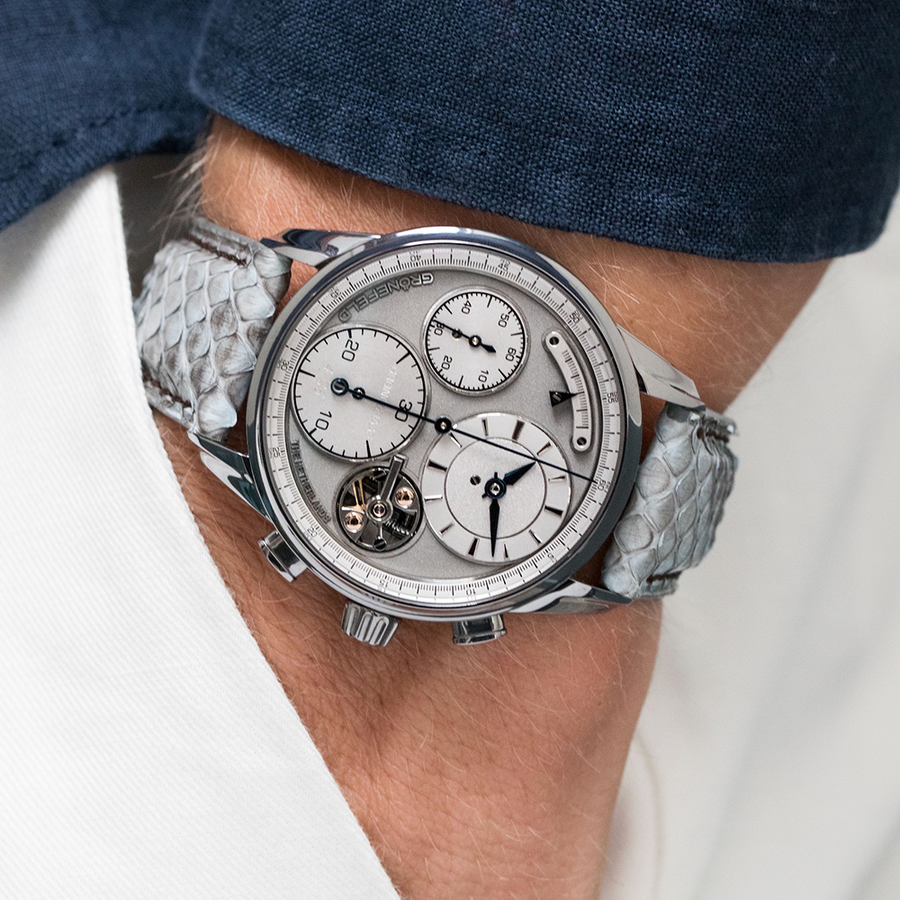
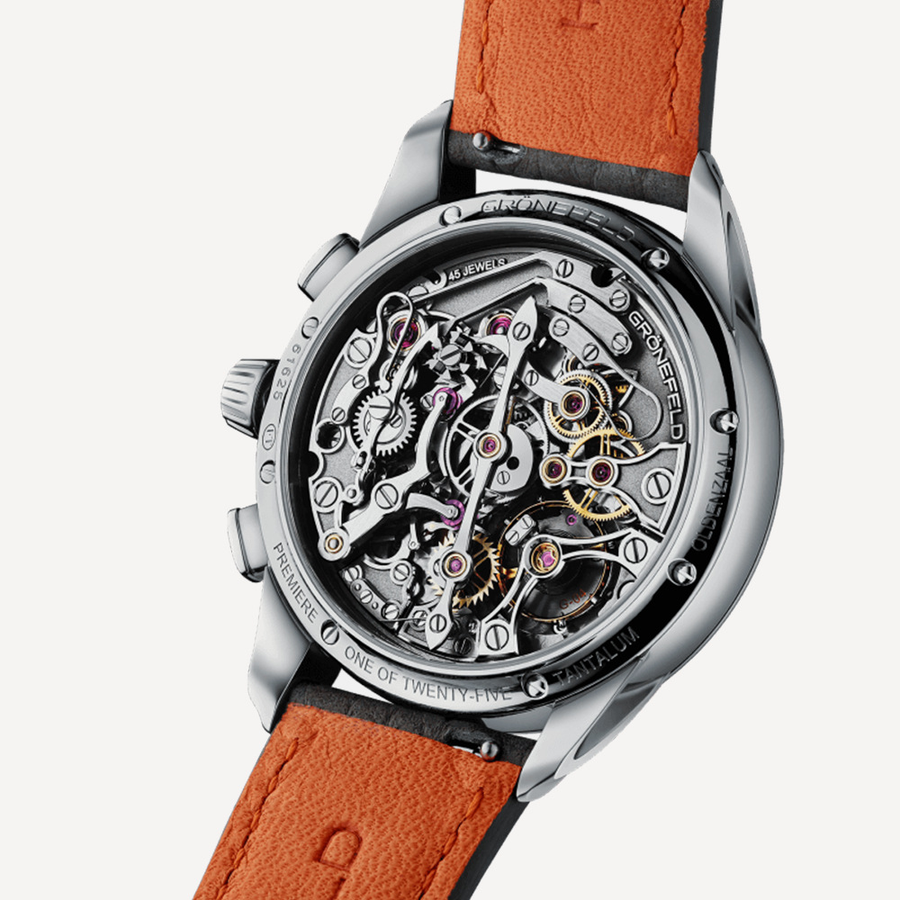
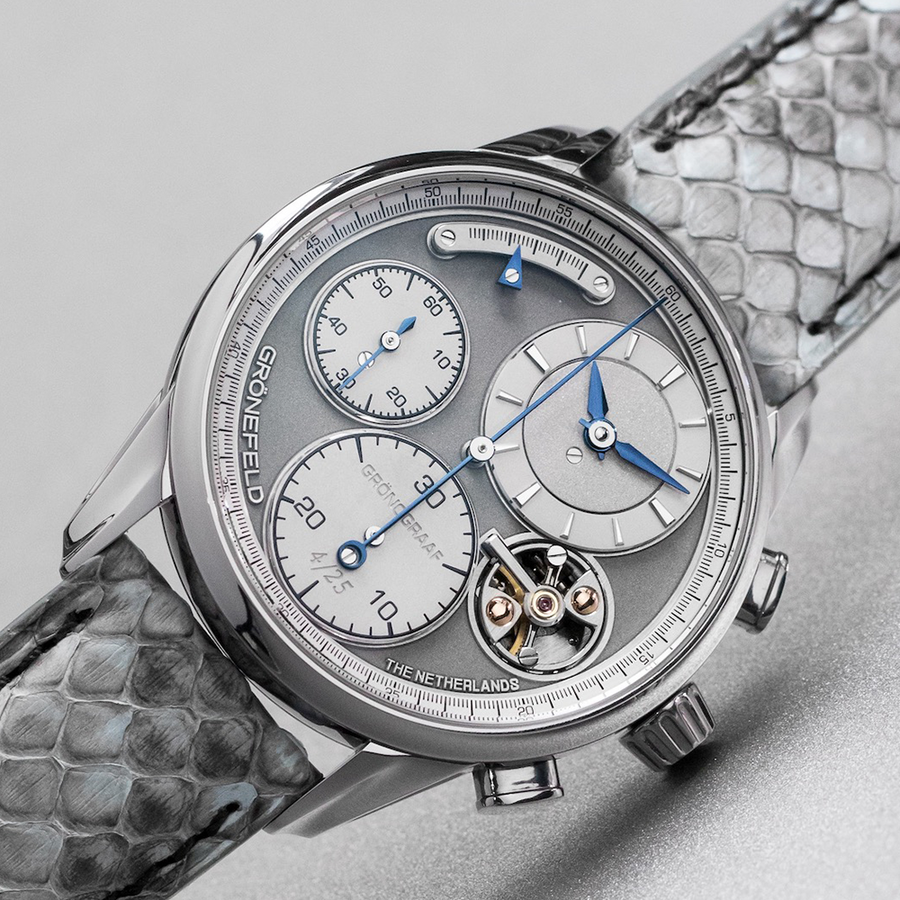
The 1941 Remontoire introduced the 1941 case in 2016, and it won the Men’s Watch category at the same prize. The 1941 Grönograaf, the brothers’ first chronograph, won the Chronograph category in 2022, their third award there. In 2026 the 1941 Quadrivium brought four of their complications into one watch: a 7.5-second remontoire, a one-minute flying tourbillon, central jumping seconds and a power reserve indicator.
The house today
In 2021 the whole team moved into a building from 1886 next to the basilica. It began as a primary school, and in the 1970s it was the brothers’ own first school. In 2023 the mayor of Oldenzaal awarded Grönefeld the town’s Gold Medal of Honour, and in 2024 Bart sat on the jury of the Grand Prix d’Horlogerie de Genève. The same year the brothers launched a second brand, GRØNE, to bring watches to a wider audience.

Bart and Tim are the third generation of Grönefeld watchmakers to live and work in Oldenzaal. In 2024 their children began their watchmaking training, and with them a fourth generation has started.
At a glance
- Founded: 1912 (the family workshop); 2008 (the first Grönefeld watch)
- Founders: Johan Grönefeld (workshop); Bart and Tim Grönefeld (the watch brand)
- Based in: Oldenzaal, the Netherlands
- Known for: jumping seconds, remontoires, the 1941 case, three Grand Prix d’Horlogerie de Genève awards
- Independent: family-run by Bart and Tim Grönefeld